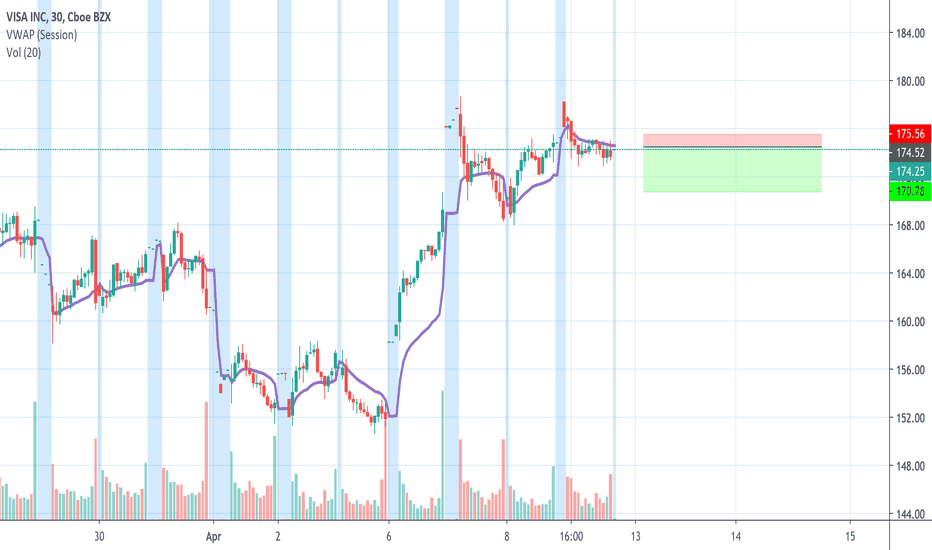
Why Is Visa Stock Going Down. Currently, analysts expect that visa will report earnings of $7.05 per share in the current fiscal year. That trade was already playing out on tuesday as visa’s stock fell nearly 3% to just below $177.
V Stock Price and Chart — NYSEV — TradingView from www.tradingview.com The different types of stock
Stock is a type of ownership in a company. Stock is a fraction the total shares that the company owns. If you purchase shares from an investment firm or you purchase it yourself. The price of stocks can fluctuate and are used for numerous purposes. Some stocks are cyclical and others aren't.
Common stocks
Common stocks are a form of equity ownership for corporations. These securities can be issued as voting shares or ordinary shares. Ordinary shares are also known as equity shares outside the United States. To refer to equity shares within Commonwealth territories, the term "ordinary shares" is also used. They are the most basic form of equity ownership for corporations and are also the most commonly held form of stock.
Common stocks share a lot of similarities to preferred stocks. The most significant difference is that preferred shares have voting rights , whereas common shares do not. Preferred stocks offer lower dividend payouts but do not give shareholders the right to vote. Also, they are worth less when interest rates rise. If rates fall and they increase, they will appreciate in value.
Common stocks have a higher potential to appreciate than other types of investments. They don't have fixed rates of return , and consequently are much cheaper than debt instruments. In addition, unlike debt instruments, common stocks are not required to pay interest to investors. The investment in common stocks is a fantastic way to benefit from increased profits and share in the company's success.
Preferred stocks
The preferred stock is an investment option that has a higher yield than the standard stock. As with all investments there are dangers. Your portfolio should diversify with other securities. This can be done by purchasing preferred stocks from ETFs and mutual funds.
Although preferred stocks typically do not have a maturity period, they are still available for redemption or could be redeemed by their issuer. The date for calling is usually five years from the date of issue. The combination of bonds and stocks can be a good investment. A bond, a preferred stock pays dividends on a regular basis. You can also get fixed payments and terms.
The advantage of preferred stocks is They can also be used as a substitute source of financing for businesses. Funding through pensions is one alternative. Some companies have the ability to hold dividend payments for a period of time without adversely affecting their credit score. This allows companies to be more flexible and lets them pay dividends when they have sufficient cash. These stocks can also be susceptible to risk of interest rates.
Non-cyclical stocks
A non-cyclical stock is one that doesn't undergo significant value fluctuations due to economic conditions. These types of stocks typically are found in industries that make items or services that customers require continuously. This is why their value rises over time. Tyson Foods, which offers a variety of meats, is a good example. These products are a well-liked investment because consumers are always in need of them. Another example of a non-cyclical stock is utility companies. They are stable, predictable, and have higher share turnover.
Customer trust is another important aspect to be aware of when you invest in stocks that are not cyclical. High customer satisfaction rates are generally the most desirable options for investors. Although companies can appear to be highly-rated but the feedback they receive is usually misleading and some customers may not get the best service. It is important to concentrate on customer service and satisfaction.
Individuals who do not wish to be exposed to unpredicted economic changes are likely to find non-cyclical stocks to be the ideal investment choice. While stocks are subject to fluctuations in price, non-cyclical stock outperforms the other types and sectors. They are often called defensive stocks as they shield investors from negative effects of the economy. Non-cyclical securities can be used to diversify portfolios and generate steady returns regardless of how the economy performs.
IPOs
A form of stock offering in which a business issues shares in order to raise funds, is called an IPO. The shares are then made available to investors at a specific date. Investors who want to buy these shares must complete an application form. The company determines how many shares it needs and allocates them accordingly.
The decision to invest in IPOs requires attention to details. Before making a decision on whether or not to make an investment in an IPO it is essential to take a close look at the company's management, the nature and the details of the underwriters as well as the terms of the deal. A successful IPOs will usually have the backing of big investment banks. There are risks in investing in IPOs.
A business can raise huge amounts of capital via an IPO. It allows financial statements to be more transparent. This increases its credibility and increases the confidence of lenders. This will help you obtain better rates for borrowing. An IPO reward shareholders of the company. After the IPO is concluded the investors who participated in the initial IPO will be able to sell their shares through a secondary market. This can help keep the price of the stock stable.
A company must comply with the SEC's listing requirements in order to qualify for an IPO. Once this step is complete and the company is ready to market the IPO. The final underwriting stage involves creating a consortium of broker-dealers and investment banks which can buy shares.
Classification of companies
There are many ways to categorize publicly traded businesses. A stock is the most commonly used method to categorize publicly traded companies. You can select to have preferred shares or common shares. The distinction between these two types of shares is in the amount of voting rights that they possess. The former allows shareholders to vote in company meetings, whereas the latter allows shareholders to vote on specific elements of the business's operations.
Another method is to categorize companies by sector. This method can be beneficial for investors who want to find the best opportunities in certain industries or sectors. There are a variety of aspects that determine if a company belongs to specific sector. For instance, a significant decline in the price of stock could negatively impact stock prices of other companies in the same sector.
Global Industry Classification Standard(GICS) or International Classification Benchmarks (ICB) Both systems assign companies according to the items they manufacture as well as the services they offer. Energy sector companies, for instance, are part of the energy industry category. Companies that deal in oil and gas are included in the drilling for oil and gaz sub-industry.
Common stock's voting rights
There have been many discussions regarding the voting rights of common stock over the past few years. A number of reasons can lead a company giving its shareholders the vote. This has led to a variety of bills to be introduced both in the House of Representatives and the Senate.
The amount of outstanding shares determines how many votes a company has. A company with 100 million shares gives you one vote. The voting rights of each class will rise when the company holds more shares than the allowed amount. A company could then issue additional shares of its stock.
Common stock may also be subject to a preemptive rights, which allow the holder a certain share of the stock owned by the company to be held. These rights are important as a corporation may issue more shares, and shareholders might want to purchase new shares in order to maintain their ownership. Common stock isn't a guarantee of dividends, and corporations are not required by shareholders to pay dividends.
How To Invest In Stocks
Stocks can offer higher yields than savings accounts. Stocks allow you to buy shares of a company and will yield significant profits if the company is prosperous. You can make money by purchasing stocks. If you own shares in a company you can sell them at a higher price in the near future while getting the same amount that you initially invested.
Investment in stocks comes with risk, just like any other investment. Your tolerance for risk and your time frame will assist you in determining the right level of risk to take on. While aggressive investors want to maximize their return, conservative investors wish to preserve their capital. Moderate investors are looking for an unrelenting, high-quality returns over a long period but don't want to risk their entire funds. Even a conservative investing strategy can result in losses therefore it is important to assess your comfort level prior to making a decision to invest in stocks.
It is possible to start investing small amounts of money after you've established your risk tolerance. It is important to research various brokers and determine which one is most suitable for your requirements. A great discount broker will provide educational tools and other resources that can assist you in making educated decisions. Certain discount brokers offer mobile apps and have low minimum deposits required. However, it is essential to be sure to check the fees and conditions of the broker you're considering.
V) has reached its near term potential. The bottom line improved 41% year. Currently, analysts expect that visa will report earnings of $7.05 per share in the current fiscal year.
Their V Share Price Forecasts Range From $204.00 To $310.00.
Currently, analysts expect that visa will report earnings of $7.05 per share in the current fiscal year. Currently, analysts expect that visa will report earnings of $7.05 per share in the current fiscal year. Visa (v) stock may not perform so well in the last six months of the current year, 2022.
After A 44% Rise Since March 23, At The Current Price Of Around $195 Per Share We Believe Visa Stock (Nyse:
The bottom line improved 41% year. Analyst estimates for visa have been moving lower in recent months. View the latest news, buy/sell ratings, sec filings and insider transactions for your stocks.
Visa Q3 Earnings Beat Estimates, Revenues Improve Y/Y.
Same thing on the bottom line,. That trade was already playing out on tuesday as visa’s stock fell nearly 3% to just below $177. Edt on news that the u.s.
And That Was A Small Beat On The Top Line.
Payment stocks are out of favor right now, and that, combined with worries about the new covid variant, has sent shares of visa (nyse:v) down by well above 20% over the last. V) has reached its near term potential. V) was down 2.3% to $203.40 around 5 p.m.
Accordingly, Shares Of Visa Stock Are Down Approximately 5% At The Time Of Writing.
Shares of credit card giant visa ( v 1.68%) stock took a tumble today, falling 5% through 12:40 p.m. First of all, the stock market doesn’t directly reflect the economy. In fiscal 2021, it processed over $10 trillion in purchase transactions.

Post a Comment for "Why Is Visa Stock Going Down"