Is Preferred Stock Debt Or Equity. For example, a preference share that is redeemable only at the holder’s request may be accounted for as debt even though legally it is a share of the issuer. Preferred equity is similar to preferred stock in the corporate world.
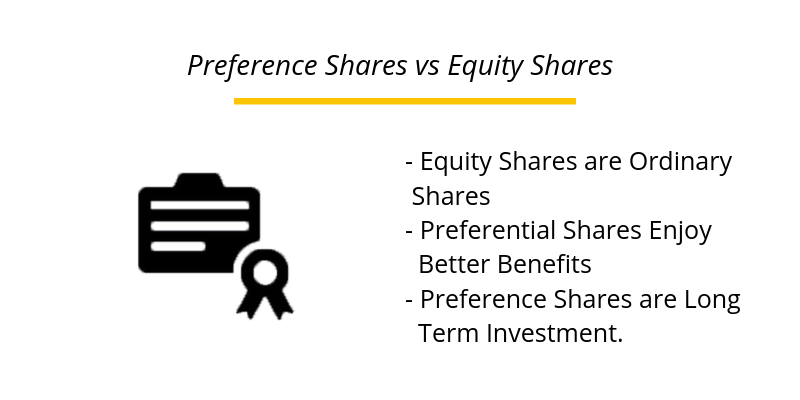
Difference Between Preference Share and Equity Shares from www.quickcompany.in The Different Types of Stocks
Stock is a type of ownership in a corporation. A stock share is a tiny fraction of the number of shares that the company owns. Stocks can be purchased from an investment firm, or you can purchase a share of stock on your own. Stocks can be used for many purposes and their value can fluctuate. Some stocks are cyclical, while others aren't.
Common stocks
Common stocks is one type of equity ownership in a company. They are typically issued in the form of voting shares or ordinary shares. Ordinary shares are often referred to as equity shares in countries other than the United States. In the context of equity shares within Commonwealth territories, the term "ordinary shares" are also utilized. They are the most basic form of corporate equity ownership and most widely owned stock.
Common stocks share many similarities to preferred stocks. Common shares can vote, whereas preferred stocks aren't. While preferred shares pay less dividends, they don't allow shareholders to vote. Therefore, if interest rates rise the value of these stocks decreases. However, if interest rates fall, they increase in value.
Common stocks have a better chance of appreciation than other types. They do not have a fixed rate of return and are much less expensive than debt instruments. Furthermore unlike debt instruments, common stocks do not have to pay interest to investors. Common stocks are a great way of getting more profits and being a part of the company's success.
Preferred stocks
These are stocks that pay higher dividend yields than regular stocks. Like any other investment, they aren't without risk. Diversifying your portfolio with different kinds of securities is crucial. One method to achieve this is to purchase preferred stocks from ETFs or mutual funds.
Stocks that are preferred don't have a date of maturity. They can, however, be purchased or exchanged by the company that issued them. This call date is usually five years after the date of issue. The combination of stocks and bonds is a great investment. These stocks offer regular dividends similar to bonds. You can also get fixed payment and terms.
They also have the advantage of offering companies an alternative funding source. One option is pension-led financing. Certain companies are able to postpone dividend payments without affecting their credit scores. This provides companies with more flexibility and permits them to pay dividends at the time they have sufficient cash. These stocks can also be susceptible to risk of interest rates.
Non-cyclical stocks
Non-cyclical stocks do not have major changes in value as a result of economic trends. These kinds of stocks are usually found in industries that make items or services that customers need frequently. Their value therefore remains constant over time. As an example, consider Tyson Foods, which sells a variety of meats. These are a well-liked investment because consumers demand them all year. Companies that provide utility services can be considered a noncyclical stock. These types of businesses can be reliable and stable , and they will also grow their share of turnover over years.
The trustworthiness of the company is another crucial factor when it comes to stocks that are not cyclical. A high rate of customer satisfaction is often the best options for investors. While some companies may appear high-rated, their customer reviews can be misleading and may not be as positive as it ought to be. Therefore, it is important to focus on businesses that provide customer service and satisfaction.
Individuals who aren't interested in being subject to unpredicted economic cycles could make excellent investments in stocks that aren't cyclical. Although the value of stocks fluctuate, non-cyclical stocks outperform their industries and other types of stocks. Because they shield investors from negative impact of economic turmoil, they are also known as defensive stocks. Non-cyclical securities are a great way to diversify portfolios and earn steady income regardless of how the economy performs.
IPOs
IPOs are a kind of stock offering in which a company issues shares in order to raise funds. These shares are offered to investors at a specific date. Investors can fill out an application form to purchase these shares. The company decides on how the amount of money needed is required and distributes shares in accordance with that.
IPOs are a complex investment that requires careful consideration of each and every detail. Before you make a choice you must be aware of the management style of the company as well as the credibility of the underwriters. Large investment banks are generally supportive of successful IPOs. There are also risks involved when you invest in IPOs.
An IPO allows a company the opportunity to raise large sums. It allows the company to become more transparent which improves credibility and lends more confidence to the financial statements of its company. This can lead to improved terms for borrowing. A IPO is a reward for shareholders in the business. Once the IPO is completed, early investors can sell their shares in a secondary market. This will help keep the price of the stock stable.
To raise money via an IPO, a company must satisfy the listing requirements of both the SEC (the stock exchange) and the SEC. After completing this step and obtaining the required approvals, the company will be able to begin marketing its IPO. The final stage of underwriting is to form a syndicate comprising investment banks and broker-dealers who can purchase shares.
Classification of businesses
There are many ways to categorize publicly traded businesses. The stock of the company is one method to classify them. Common shares can be either common or preferred. There are two main distinctions between them: how many voting rights each share has. The former gives shareholders the right to vote at company meeting, while the second allows shareholders to cast votes on specific aspects.
Another approach is to separate businesses into various sectors. This method can be beneficial for investors that want to find the best opportunities within certain sectors or industries. There are many factors that determine the possibility of a business belonging to a certain sector. The price of a company's stock could drop dramatically, which could affect other companies in the same industry.
Global Industry Classification Standard and International Classification Benchmark (ICB), systems use the classification of services and products to categorize companies. Energy sector companies for example, are part of the energy industry group. Companies in the oil and gas industry are part of the drilling for oil and gaz sub-industry.
Common stock's voting rights
The rights to vote of common stock have been the subject of a number of arguments throughout the many years. There are many reasons a business could give its shareholders voting rights. This has led to various bills being introduced by both the House of Representatives as well as the Senate.
The number and value of shares outstanding determine the number of shares that have voting rights. If 100 million shares remain outstanding that means that all shares will have the right to one vote. The company with more shares than authorized will have a greater voting power. Thus, companies are able to issue more shares.
Preemptive rights can also be obtained with common stock. These rights permit the holder to keep a specific proportion of the stock. These rights are vital in that corporations could issue additional shares, or shareholders may want to acquire new shares in order to retain their ownership. It is crucial to remember that common stock doesn't guarantee dividends, and companies are not required to pay dividends to shareholders.
Investment in stocks
Stocks will help you get higher yields on your investment than you can with a savings account. Stocks let you buy shares of companies , and they can bring in substantial gains in the event that they're successful. You can also make money by investing in stocks. If you own shares in the company, you are able to sell them at higher prices in the near future while receiving the same amount as you initially invested.
The investment in stocks comes with a risks, as does every other investment. The risk level you're willing to accept and the timeframe in which you intend to invest will depend on your risk tolerance. Aggressive investors seek maximum returns regardless of risk, while prudent investors seek to safeguard their capital. Moderate investors want a steady and high-quality return for a long period of time, but they do not want to risk their entire capital. Even the most conservative investments could result in losses, so it is important to decide how comfortable you are prior to making a decision to invest in stocks.
Once you've determined your risk tolerance, only small amounts of money can be put into. Additionally, you must research different brokers to determine which one best suits your needs. A great discount broker can provide you with educational tools as well as other resources to aid you in making an informed decision. The requirement for deposit minimums that are low is the norm for some discount brokers. Some also offer mobile applications. It is crucial to examine all fees and conditions before making any decision about the broker.
Preferred equity is subordinate to all debt, but superior to all common equity. Preferred stock (also called preferred shares, preference shares, or simply preferreds) is a component of share capital that may have any combination of features not possessed by. Preferred equity, such as “preferred stock” in a corporation or “preferred membership interest” in an llc, can be structured to allow investors to receive fixed,.
Preferred Stock May Have Characteristics Of Equity, Debt, Or Both.
Hence the classification of preference shares under debt or equity would depend upon the type and nature of preferred stock. A company that finances a transaction using preferred equity usually sees a preferred return. However, perpetual preferred stock may be classified as mezzanine equity if the preferred shareholders control.
The Hybrid Nature Of Preferred Stock.
From the perspective of a financial analyst, preferred shares are treated like debt when calculating free cash flow to equity because it is not considered equity. Preferred stock (also called preferred shares, preference shares, or simply preferreds) is a component of share capital that may have any combination of features not possessed by. While preferred stock does represent ownership of an equity share in a company, as is the case with common stock, it also has characteristics of.
Perpetual And Cumulative Preferred Stock Cumulative Preferred.
In general, perpetual preferred stock is classified as permanent equity. Preferred stock is considered a hybrid security because it has the characteristics of both a debt and an equity. As we mentioned earlier, mezzanine debt and preferred equity are much less costly than issuing common equity, which has rates as high as 20%.
As With Common Stock, Shareholders Receive A Share Of Ownership In The Company.
Preferred equity is subordinate to all debt, but superior to all common equity. Preferred stock holders have a claim. Preferred stock is equity, but it is a fixed income security.
Preferred Equity, Such As “Preferred Stock” In A Corporation Or “Preferred Membership Interest” In An Llc, Can Be Structured To Allow Investors To Receive Fixed,.
Preferred stock may or may not have a fixed term. Preferred equity is similar to preferred stock in the corporate world. The main reason to treat preferred stock as debt rather than equity is that it acts more like a bond than a stock, and investors buy it for current income,.
Share
Post a Comment
for "Is Preferred Stock Debt Or Equity"

Post a Comment for "Is Preferred Stock Debt Or Equity"